
 Call Us
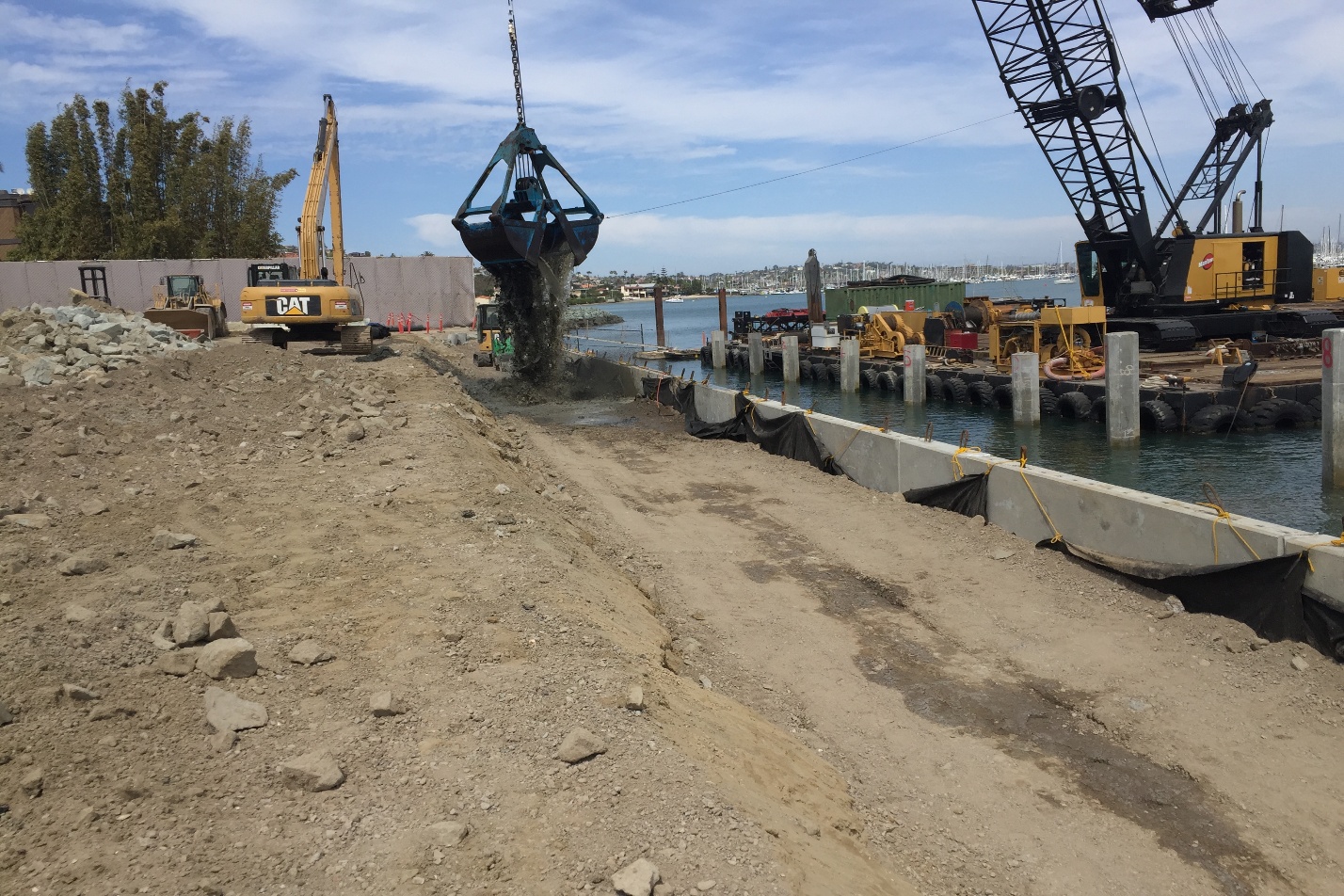
On a dredging project, removing the sediment is often the simple part. The harder question is where it goes. Dredged material management is the process of testing, transporting, treating, and placing sediment once it has been removed from a harbor, channel, or lagoon. In Southern California, every cubic yard must be tested and approved for a specific destination before it moves: ocean disposal, beneficial reuse on a beach or habitat site, or upland disposal on land. That destination often sets a dredging project’s cost and schedule more than the dredging itself.
Public works teams and port operators tend to budget dredging by the cubic yard removed. The bigger questions usually come afterward. Is the sediment clean enough for the ocean? Is it sandy enough for a beach? Is it too wet to truck? Could it contain old military ordnance? Each answer changes where the material can go and what it costs to get there.
At Marathon Construction, dredging, upland disposal, material drying, and UXO screening of dredged material are all part of the same scope, and we plan them together. This article explains how sediment is tested and approved, the main placement options in the San Diego region, how wet material is dried for hauling, and why ordnance screening is a real factor in local harbors.
Why the Destination Drives Cost and Schedule
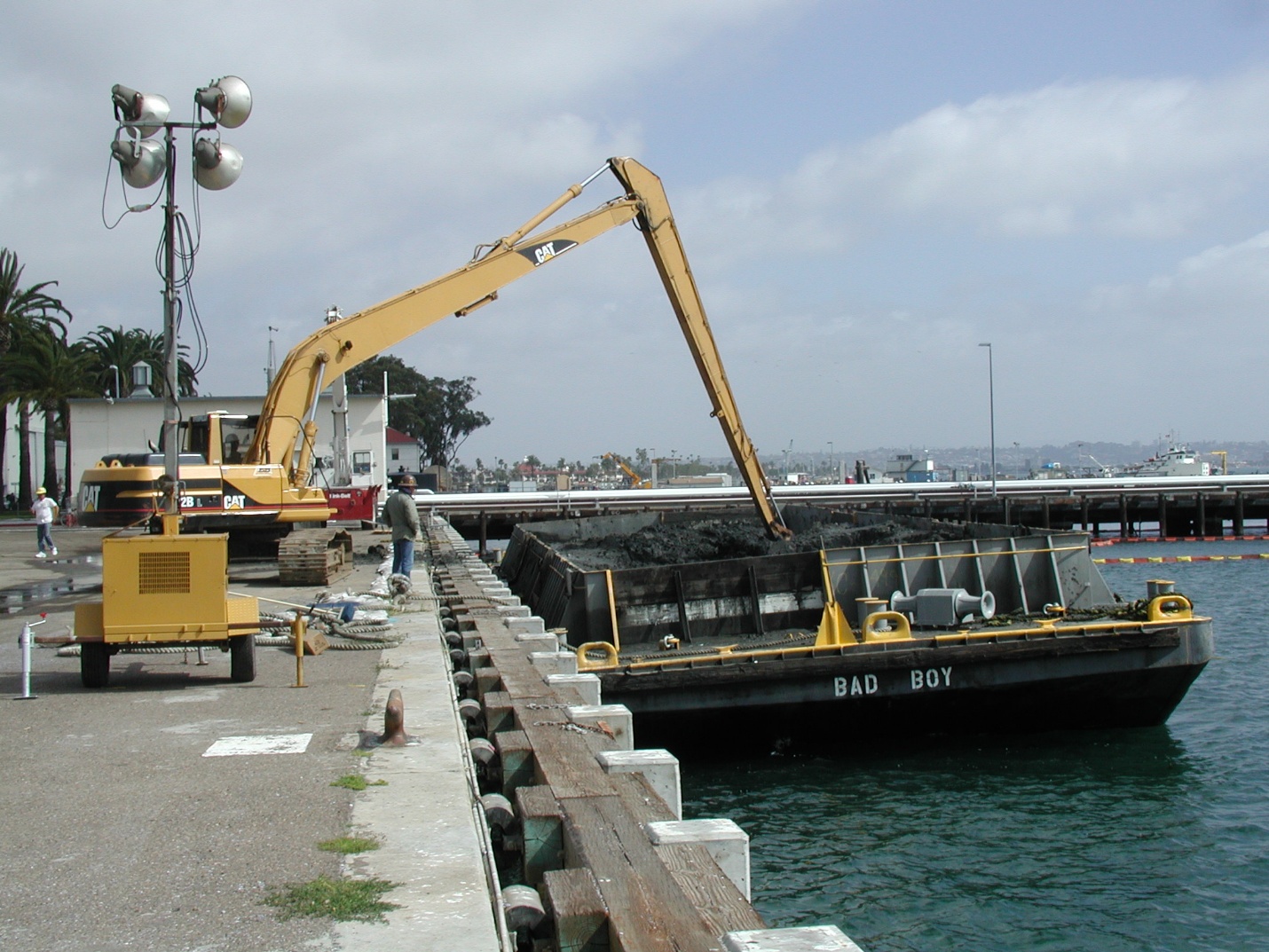
Removing sediment from the seafloor is only the first step. The material then has to be loaded, moved, and placed somewhere that has agreed to accept it, under permit conditions that control how it gets there.
Placement costs vary widely depending on the route. Clean, sandy sediment pumped to a nearby beach or released at an approved ocean site may cost relatively little to handle. Fine, silty, or contaminated sediment that must be dried, trucked, and accepted by a landfill can cost several times more per cubic yard. The difference comes from double handling, trucking distance, landfill tipping fees, and the extra time needed to dry the material.
Schedule follows the same pattern. Testing and agency review often take months, and they have to be finished before a contractor can build a reliable bid. Owners who start sediment testing early in planning tend to avoid surprises at bid time and during construction.
Step One: Characterizing the Sediment
Before any dredged material can be placed, its physical and chemical makeup has to be documented and reviewed by the regulators who will approve its destination. This work is usually completed by the owner’s environmental team before a contractor is selected, but its results shape nearly every decision the contractor makes afterward.
The Sampling and Analysis Plan
In Southern California, sediment testing is coordinated through the Southern California Dredged Material Management Team (SC-DMMT). The team brings together the U.S. Army Corps of Engineers, the U.S. Environmental Protection Agency, the Regional Water Quality Control Board, and the California Coastal Commission, which allows one testing program to support several permits.
The process starts with a Sampling and Analysis Plan (SAP) describing where cores will be taken, how deep they will go, how samples will be grouped, and which tests will be run. The agencies review and approve the plan before any sampling begins. After testing, the results are submitted in a report, the agencies issue a preliminary decision on where the material is suitable to go, and the Corps makes the final suitability decision as part of its permit.
Physical, Chemical, and Biological Testing
Physical testing measures grain size and the split between sand, silt, and clay. Grain size decides whether material can be used on a beach and how it will behave during handling and drying, which makes it one of the first numbers a contractor looks at.
Chemical testing checks for metals, petroleum-related compounds, PCBs, pesticides, and organotin. Organotin come from older anti-fouling hull paints, so they are a common concern near shipyards and naval piers.
Biological testing is required when material is headed for open water and chemistry alone cannot show it is safe. Laboratory tests expose small marine organisms such as amphipods and worms to the sediment to measure survival. Longer bioaccumulation tests, often 28 days with clams and worms, check whether contaminants build up in living tissue.
Results are compared against a reference site and federal screening values. Material that passes is cleared for open-water or reuse options. Material that fails is limited to upland disposal or further treatment.
The Three Main Placement Paths
Once sediment is characterized, it is matched to a destination. Larger projects often split material among more than one, based on how test results vary across the dredge footprint.
Ocean Disposal
The San Diego region’s designated ocean disposal site, known as LA-5, sits about seven miles southwest of Point Loma in roughly 460 to 660 feet of water. The site is managed jointly by EPA Region 9 and the Army Corps, and its use requires a permit under Section 103 of the Marine Protection, Research, and Sanctuaries Act. Material is carried out in scows and released inside a defined disposal zone, with tracking systems recording each load’s position at release.
Ocean disposal is usually the most direct path for clean, fine-grained sediment that is not suitable for beaches. It still requires passing biological testing, and haul cycles depend on weather and sea conditions. Because the site has limited capacity over its life, regulators also expect owners to show that reuse options were considered first. A dredging plan that relies only on ocean disposal may face more questions during review.
Beneficial Reuse
State policy encourages keeping clean sediment in the coastal system rather than treating it as waste. Sandy material can be used to nourish eroded beaches, the subject of our recent article Beach Replenishment: How the Work Gets Done. Other reuse options include raising grades in tidal wetland restoration, capping contaminated areas, and fill for levees, roads, and construction sites.
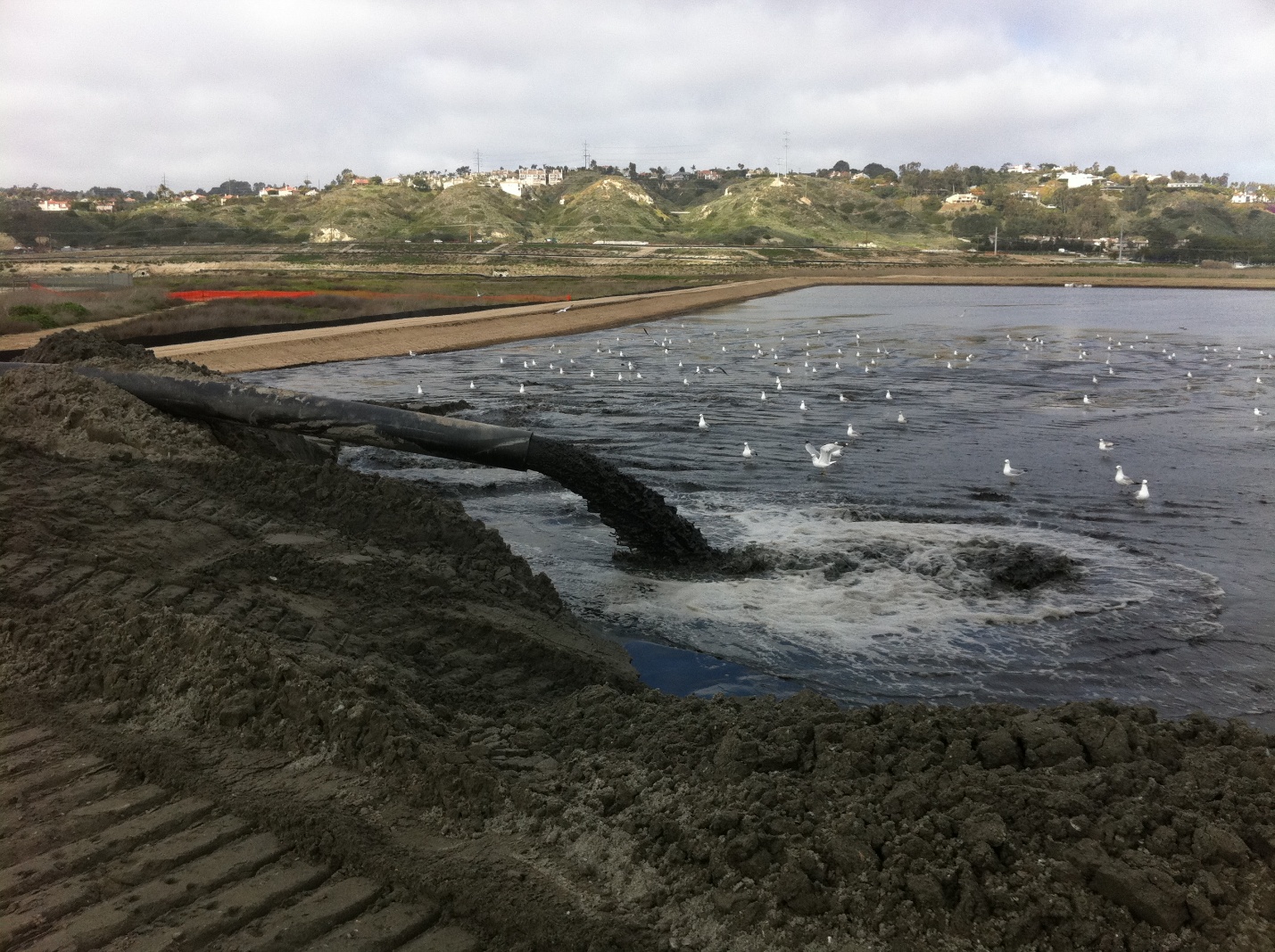
Reuse often requires a closer grain-size match and careful timing, but it turns a disposal cost into a project resource. At Batiquitos Lagoon, our crews used a 12-inch cutterhead suction dredge to remove approximately 118,000 cubic yards of beach-quality sand from the lagoon’s central basin and place it on the adjoining beach, returning it to the shoreline instead of hauling it away.
Upland Disposal
Sediment that fails testing for open water, or has no reuse partner, goes to an upland site such as a permitted landfill. Each receiving facility has its own acceptance criteria, and material that exceeds state hazardous waste thresholds must go to a facility licensed to handle it. Upland disposal almost always involves dewatering, trucking, and detailed tracking, which makes it the most expensive route per cubic yard. On the Nimitz Marine Facility wharf and pier replacement in Point Loma, about 11,000 cubic yards of dredging and shoreline excavation went to upland disposal as part of our scope.

Dewatering and Drying Before Trucking
Freshly dredged sediment can be more water than solid. Landfills and haul trucks generally will not accept material that drips or flows, so it has to be dried before it leaves the site. The usual standard is passing a paint filter test, which confirms that no free liquid drains from a sample.
Contractors rely on three main approaches. Drying basins and rehandling areas let material settle and drain over time, with crews turning it to speed evaporation. This works well where space is available but can take weeks. Geotextile tubes are large fabric containers filled with pumped sediment; water drains through the fabric while solids stay inside, which saves space and pairs well with hydraulic dredging. Amendments such as cement or lime can be mixed into wet sediment to bind water and firm up the material quickly. They add material cost but can save weeks of drying time.
The water drained from sediment must be collected and managed under the project’s discharge permit before it returns to the bay. Because material drying is part of our dredging capabilities, we plan dewatering together with the dredging rather than handing it off as a separate job. Our article on how marine construction crews maintain water quality covers more of the controls involved.
Screening for Unexploded Ordnance
San Diego Bay has been an active naval harbor for more than a century. Old practice rounds, fuzes, and other munitions can still be buried in harbor sediment, especially near historic piers, ranges, and ship channels.
The risk is well documented. In 1997 and 1998, more than 5.4 million cubic meters of sediment were dredged to deepen San Diego Harbor for Nimitz-class aircraft carriers. Much of that sand was slated for beaches around the county, but in September 1997 munitions, including live rounds, turned up in material being placed at South Oceanside Beach. By that November, the Navy had halted beach placement and sent the remaining material to ocean disposal. The lesson for later projects was clear: plan for ordnance before dredging starts, not after it turns up on a beach.
Ordnance screening typically combines a historical records review, magnetometer surveys of the dredge area, and mechanical screening of dredged material through bar screens or grizzlies that catch larger objects. Trained ordnance technicians inspect and handle any items found. Screening has to be matched to the dredging method and the final destination, since material bound for a public beach needs a higher level of confidence than material bound for a landfill. UXO screening of dredged material is one of the specialized services in our capabilities.
Logistics: Moving Material From the Water to Its Destination
Every cubic yard has to be tracked from the dredge to its final placement. Good logistics planning keeps the dredge working instead of waiting on barges, trucks, or staging space.
Transfer points, where material moves from scow to shore, need room for offloading equipment, stockpiles, and drying. Waterfront land near the dredge site is usually scarce, so securing it early matters, and the transfer area needs controls to keep sediment and runoff out of storm drains. Haul planning sets truck counts, routes, and work hours, and local agencies may limit truck traffic through neighborhoods or during peak hours. Load tracking records the volume, source area, and destination of every load, which supports permit compliance, payment quantities, and agency reporting at closeout.
For the contractor, this is where a dredging plan either holds together or comes apart. Production on the water can only move as fast as the slowest link on land.
Building Sediment Management Into the Contract
How dredged material is described in the bid documents has a direct effect on pricing and risk. From the bidder’s side of the table, four provisions make the biggest difference.
Separate pay items by destination. Listing ocean disposal, beneficial reuse, and upland disposal as separate bid items with their own unit prices lets the owner pay fairly if volumes shift between routes once dredging begins.
Share all test data with bidders. Grain size, chemistry, and core logs help contractors choose the right equipment and drying method. When data is withheld, every bidder prices the uncertainty.
Define how volume is measured. Payment can be based on before-and-after hydrographic surveys, scow measurements, or truck weights, and each gives a different number. The contract should name one method and explain how allowable over-depth will be handled.
Plan for ordnance and unknowns. A clear process for stopping work, notifying the owner, and adjusting the schedule if munitions or unexpected contamination are found avoids disputes in the field.
Owners weighing how to procure a complex dredging job may also find our article on alternative delivery methods for coastal and heavy civil projects useful, since bringing a contractor in early can settle many of these questions before bid day.
Common Mistakes in Dredged Material Management
The problems we see most often on dredging projects are predictable, which means they are preventable.
Testing too late tops the list. Starting the sampling plan after design is complete often pushes the bid date back by months. Using too few sample locations is close behind, because grouping cores from very different areas can hide a contaminated pocket that later forces a large volume to upland disposal.
On the construction side, fine sediment dries slowly, and an undersized staging area can stall the dredge for days at a time. In a historic naval harbor, skipping ordnance review risks finding munitions mid-project, which can stop work, trigger new safety requirements, and close a placement site. And beaches, restoration sites, and landfills each have their own windows and daily limits. If the receiving site cannot take material at the dredge’s pace, the whole operation slows down.
Why Experience Matters in Dredged Material Management
A dredging project is only as successful as the plan for where the sediment goes. Testing, agency coordination, drying, ordnance screening, contract terms, and logistics all need to line up before the first bucket or cutterhead reaches the bottom.
Marathon Construction Corporation is a family-owned marine and heavy civil contractor based in Lakeside, with 42 years in business and more than 450 completed projects across the Western United States. Dredging, upland disposal, material drying, and ordnance screening are handled by the same team, from maintenance dredging at Batiquitos Lagoon to dredging and upland disposal at the Nimitz Marine Facility in Point Loma. That field discipline carries into our environmental and habitat restoration work, including the San Dieguito Lagoon Restoration, named a 2025 APWA Project of the Year.
To discuss an upcoming dredging project, explore our dredging capabilities, review our project history, or contact Marathon Construction Corporation through our contact page to talk through

 Address
 Email Us
 Contact