
 Call Us
Marathon Construction Corporation
Beach replenishment may look simple from the shoreline: move sand onto an eroded beach and restore the beach profile. In practice, the construction process can involve dredging, marine equipment, temporary pipelines, heavy earthmoving equipment, environmental restrictions, tides, surf conditions, limited access, and the movement of very large quantities of material.
At Marathon Construction, our focus is on the means and methods required to turn an engineered beach replenishment plan into a completed project. Every site is different, but successful execution usually comes down to the same fundamentals: obtaining the specified material, moving it efficiently, controlling placement, working within environmental and operational constraints, and maintaining production in a difficult marine environment.
How Beach Replenishment Construction Works
A beach replenishment project typically begins with an engineered design establishing the limits of placement, required sand quantities, beach elevations, slopes, and material requirements. From the contractor’s standpoint, the next question is how to physically move that material from its source to the beach.
The sand may come from an offshore borrow area, navigation channel, inlet, reservoir or sediment basin, or another approved source. Once the source is established, the contractor develops the equipment spread and construction sequence required to excavate, transport, place, and grade the material.
Hydraulic Dredging and Pipeline Placement
For large beach replenishment projects, hydraulic dredging is often one of the most efficient methods of moving sand.
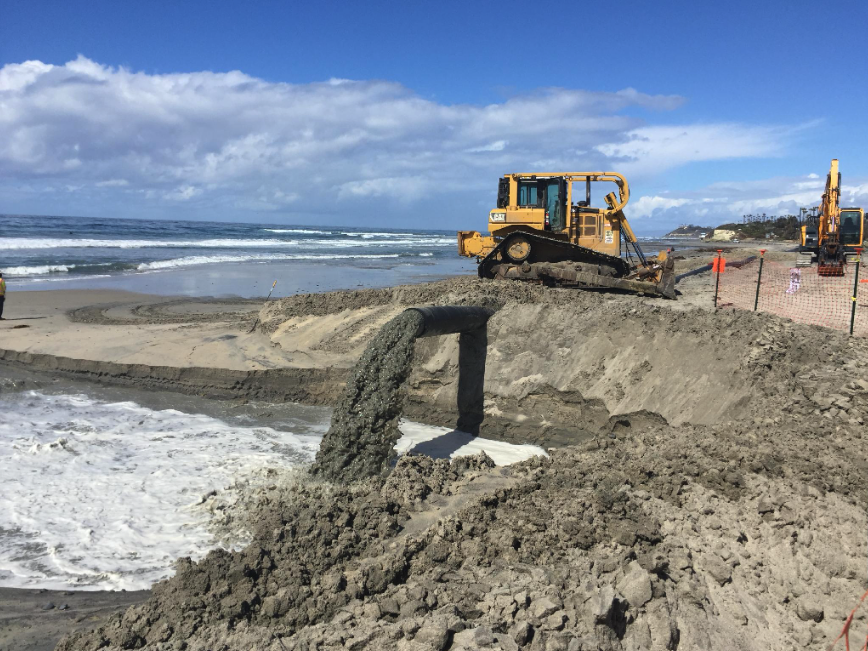
A hydraulic dredge excavates material and mixes it with water to create a slurry. The mixture is pumped through floating and submerged pipeline and then through shore-based discharge pipe to the placement area.
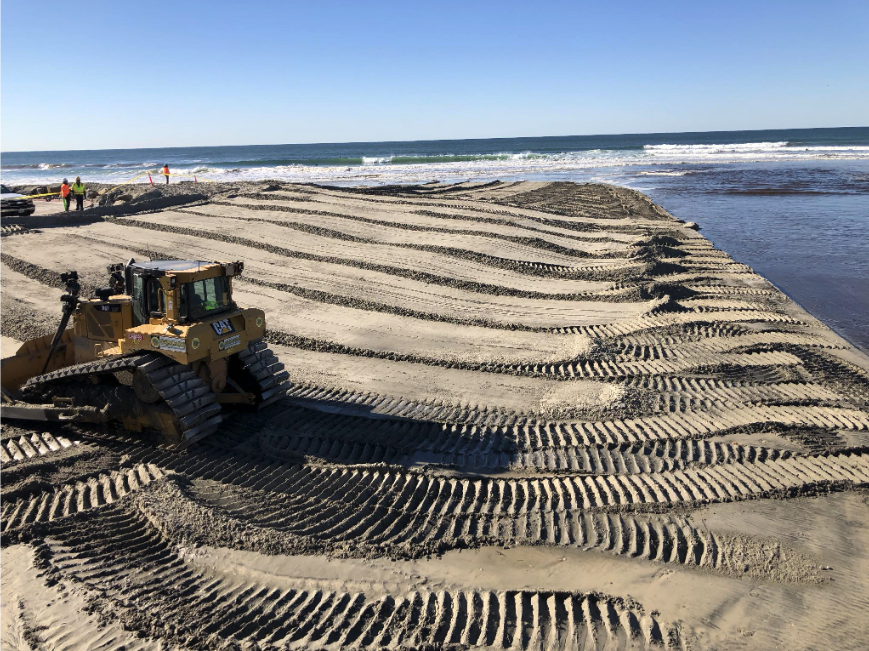
Once the slurry reaches the beach, the construction operation becomes a combination of pumping and earthmoving. Bulldozers, excavators, loaders, and other equipment manage the discharge as material builds on the beach. Crews move the discharge point as construction progresses and grade the sand to the elevations and slopes shown on the project plans.
The contractor must keep the hydraulic operation and the landside grading operation coordinated so the dredge can continue producing without overwhelming the placement area. Pipeline management is an important part of the operation. As work advances, crews may add, remove, relocate, or reposition sections of discharge pipe so the sand is delivered where it is needed.
Mechanical Dredging and Material Transport
Hydraulic dredging is not practical for every project. Where material needs to be excavated selectively, where access is constrained, or where site conditions favor mechanical handling, sand may be excavated using a clamshell, excavator, or other mechanical dredging equipment.
The material can then be placed into barges, scows, trucks, or other transportation equipment before being delivered to the beach. The choice between hydraulic and mechanical dredging depends on factors such as water depth, material characteristics, transportation distance, production requirements, access, and the placement location.
From a contractor’s perspective, the objective is to develop the equipment spread that provides the required production while remaining practical for the specific site.
Getting Sand From the Water to the Beach
One of the most important constructability questions is how the material transitions from the marine environment to the active beach.
Depending on the project, that may involve direct hydraulic discharge through a pipeline extending onto the beach, pumping from a dredge or booster pump station, unloading material from barges or scows, excavating material from a nearby sediment source, or truck hauling from an approved upland source.
Each method creates different access, staging, production, and equipment requirements. A pipeline operation may require temporary crossings and frequent relocation of pipe. A truck-haul operation requires haul routes, traffic control, staging space, and enough room for trucks and earthmoving equipment to operate simultaneously.
The best means and methods are often driven as much by site logistics as by the quantity of sand being placed.
Spreading and Grading the Beach
Delivering the sand is only part of the work. Once material reaches the beach, it must be distributed across the placement area and graded to the required configuration. The project plans generally establish the required limits, elevations, slopes, and beach cross section.
During placement, earthmoving equipment spreads the incoming sand and progressively builds the beach outward and alongshore. Crews shape the placed material to the specified slope and elevation and use survey and grade-control information to keep the work within the project tolerances.
Production requires close coordination. If the dredge is pumping continuously, the grading operation must keep pace. Too much material concentrated in one location can restrict pipeline operations and reduce production. Experienced crews continuously manage the relationship between dredging production, pipeline location, discharge location, grading equipment, tides, and available working area.
Equipment Used on Beach Replenishment Projects
The equipment spread varies significantly by project. Marine equipment may include cutterhead or hopper dredges, mechanical dredges, barges, scows, tugboats, workboats, booster pumps, floating pipeline, anchors, and support vessels.
Beach-side equipment may include bulldozers, excavators, wheel loaders, articulated trucks, graders, skid steers, pumps, and utility vehicles.
The contractor’s equipment plan needs to account not only for production but also for mobilization, maintenance, fueling, access, environmental restrictions, and the ability to safely operate equipment on loose sand and near the water. A piece of equipment that performs well on a conventional earthwork project may operate very differently on a beach affected by tides, waves, saturated sand, and limited access.
Working With Tides, Waves, and Weather
Beach replenishment is rarely a conventional daytime construction operation. Marine conditions affect nearly every aspect of production. Tides change the available working area. Waves affect pipeline, vessels, and shoreline operations. Storms can interrupt dredging and reshape recently placed material.
The contractor has to build those conditions into the construction sequence. Equipment may need to move as the tide changes. Pipeline may require additional anchoring or repositioning. Marine operations may be suspended when conditions exceed safe operating limits. Crews may also need to adjust placement operations to keep equipment out of areas affected by changing surf conditions.
For the contractor, that means maintaining flexibility while still meeting production goals.
Environmental Compliance During Construction
Environmental requirements have a direct effect on construction means and methods. Beach replenishment projects commonly include restrictions associated with water quality, sensitive habitat, fisheries, nesting birds, grunion, marine mammals, or other site-specific resources.
Once construction starts, those requirements become operational constraints. They may affect where equipment can travel, when dredging can occur, allowable work hours, pipeline routes, lighting, turbidity controls, monitoring requirements, or the timing of particular construction activities.
The contractor’s job is to incorporate those requirements into the work plan rather than treating them as separate from construction.
Sand Characteristics Matter to Construction
Although material suitability is established through the project’s engineering and environmental process, sand characteristics also affect construction.
Fine material behaves differently than coarse sand when it is pumped through a pipeline. Material containing oversized debris may affect dredging and pumping equipment. Moisture content can influence trucking and handling. Grain characteristics can affect how material spreads after discharge.
The project specifications generally establish acceptable material characteristics, and the contractor develops the excavation, transportation, and placement methods around those requirements.
Production and Sequencing
Large beach replenishment projects are fundamentally production operations. A successful project requires the dredging, transportation, pumping, pipeline, and earthmoving operations to function as one coordinated system.
If the dredge produces faster than the beach crews can handle the material, production slows. If pipeline relocation takes too long, the dredge may sit idle. If grading equipment cannot access the discharge area, placement stops.
Experienced marine contractors plan the work around these interfaces. That includes identifying staging areas, planning pipeline routes, determining how equipment will access the beach, establishing fueling and maintenance procedures, coordinating survey and grade control, and sequencing work so one operation does not unnecessarily restrict another.
Access and Public Coordination
Many replenishment projects are constructed on public beaches. That creates another layer of logistics. The contractor may need to maintain pedestrian access, establish temporary closures, relocate access routes as work advances, and separate the public from heavy equipment and active pipeline.
Construction limits may move continuously along the beach as placement progresses. Maintaining clear work zones while keeping the project moving requires daily coordination between field supervision, equipment operators, public agencies, inspectors, environmental monitors, and other project stakeholders.
Why Contractor Experience Matters
The engineering establishes what the finished beach should look like. The contractor determines how to build it.
Beach replenishment requires the coordination of marine construction, dredging, pipeline operations, heavy earthmoving, surveying, environmental compliance, equipment logistics, and field production.
The challenge is not simply putting sand on a beach. It is moving large quantities of material efficiently through a changing marine environment while maintaining safety, environmental compliance, grade requirements, and production.
Marathon Construction brings decades of marine and heavy civil construction experience to that part of the process. Our role is to develop practical means and methods, assemble the right equipment and crews, and execute the work under the conditions that exist in the field.

 Address
 Email Us
 Contact